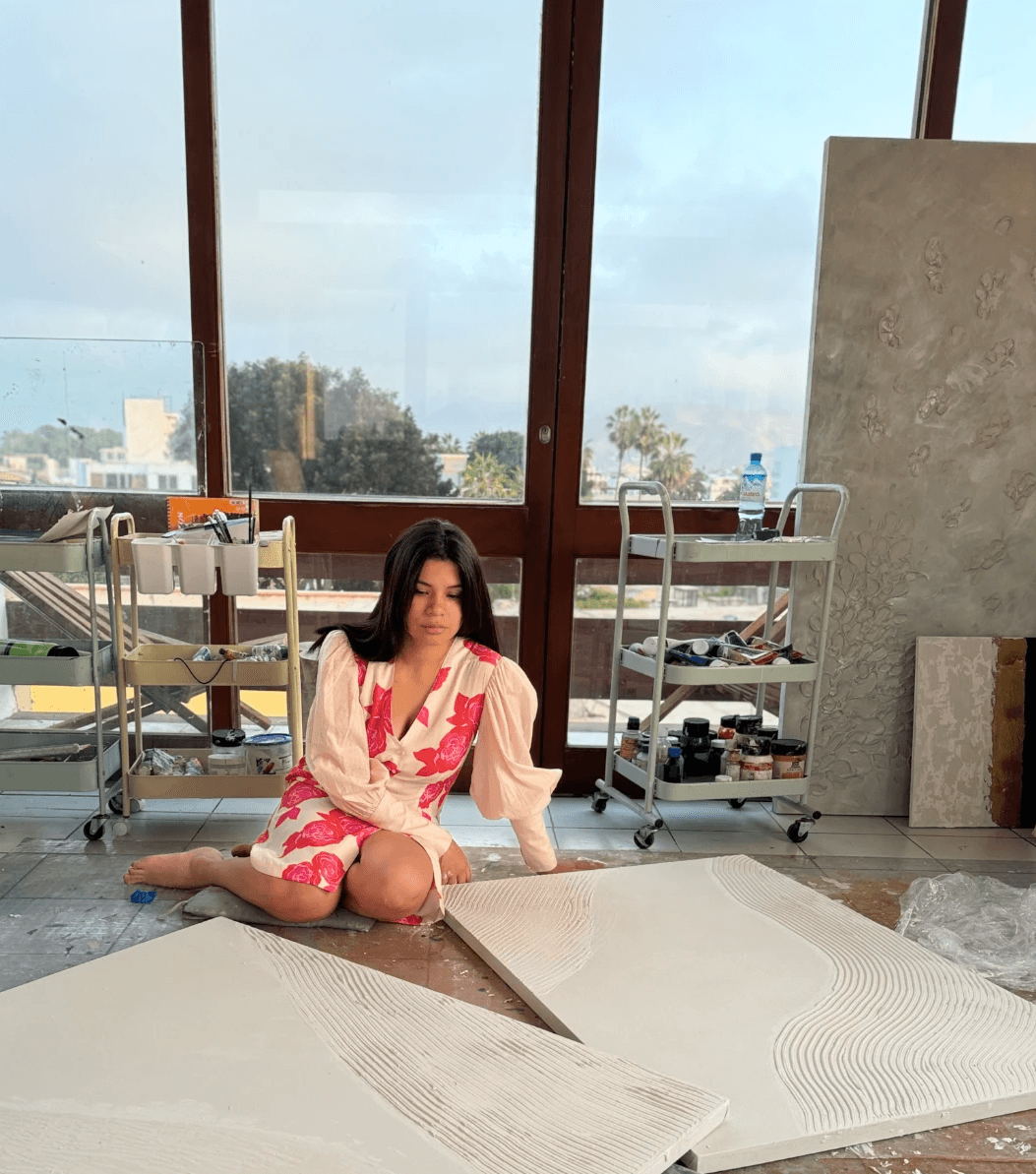
La estética de lo vivo
¿Dónde reside la verdadera belleza de una forma? Para mí, lo sublime no se encuentra en lo pulcro ni en lo estático. Una superficie plana es una superficie sin historia. Mi trabajo es una rebelión contra lo inerte: busco que el lienzo respire a través de la textura y el relieve, permitiendo que la imperfección sea la que dicte la narrativa. Pinto porque necesito tocar la luz y darle cuerpo a la fluidez, creando espacios donde el ojo pueda perderse en los accidentes del material.
¿Cómo habitamos la tensión entre lo fluido y lo sólido? Mi práctica es un diálogo constante con la materia. Me fascina el momento en que una mancha de color encuentra su límite o cuando una textura orgánica se expande con libertad. No busco el control absoluto, sino esa cualidad vibrante de lo que parece estar aún en formación. En esa dualidad —entre lo que es suave y lo que tiene la fuerza de la tierra— es donde encuentro mi voz: una identidad que se construye capa sobre capa, aceptando cada relieve como parte de un todo vivo.
¿Qué nos dice el silencio de lo cotidiano? Mis obras son una invitación a detenerse ante lo que otros ignoran. Ya sea el tono dorado de un atardecer o la quietud de un bosque nublado, mi búsqueda es siempre la misma: capturar la resiliencia de lo que nace, cambia y permanece. Es una declaración de fortaleza que nace de la sensibilidad, recordándonos que somos más poderosos cuando nos permitimos ser auténticos, vulnerables y, sobre todo, humanos.
What this exhibition explores
The Shape of Knowledge examines how images preserved in old books—engravings, diagrams, botanical drawings, astronomical charts, early photographs—gave form to ideas long before modern visualization tools existed.
The exhibition explores the ways in which people once interpreted nature, science, society, and the cosmos through images, revealing how knowledge was shaped, structured, and communicated visually.
Why this exhibition was conceived
The exhibition begins with a simple question: how did earlier generations visualize what they sought to understand?
Many of these images were created not as art objects but as instruments of explanation—yet, when viewed today, they exhibit an aesthetic precision and conceptual ambition that far exceed their original purpose.
The Shape of Knowledge invites viewers to reconsider these works not just as historical artifacts but as evidence of a long-standing human impulse: to give shape to the unknown through observation, imagination, and visual form.
The perspective that shapes this exhibition
Rather than presenting these materials strictly through scientific accuracy or historical chronology, The Shape of Knowledge brings together images from disparate fields—botany, astronomy, geology, sociology—through a shared perspective: the visual shaping of understanding.
The exhibition highlights how each image interprets reality in its own way, constructing meaning through line, structure, scale, and symbol.
Through this lens, the works collectively demonstrate how visual representation has long served as a bridge between the seen and the unseen, the known and the not-yet-understood.